
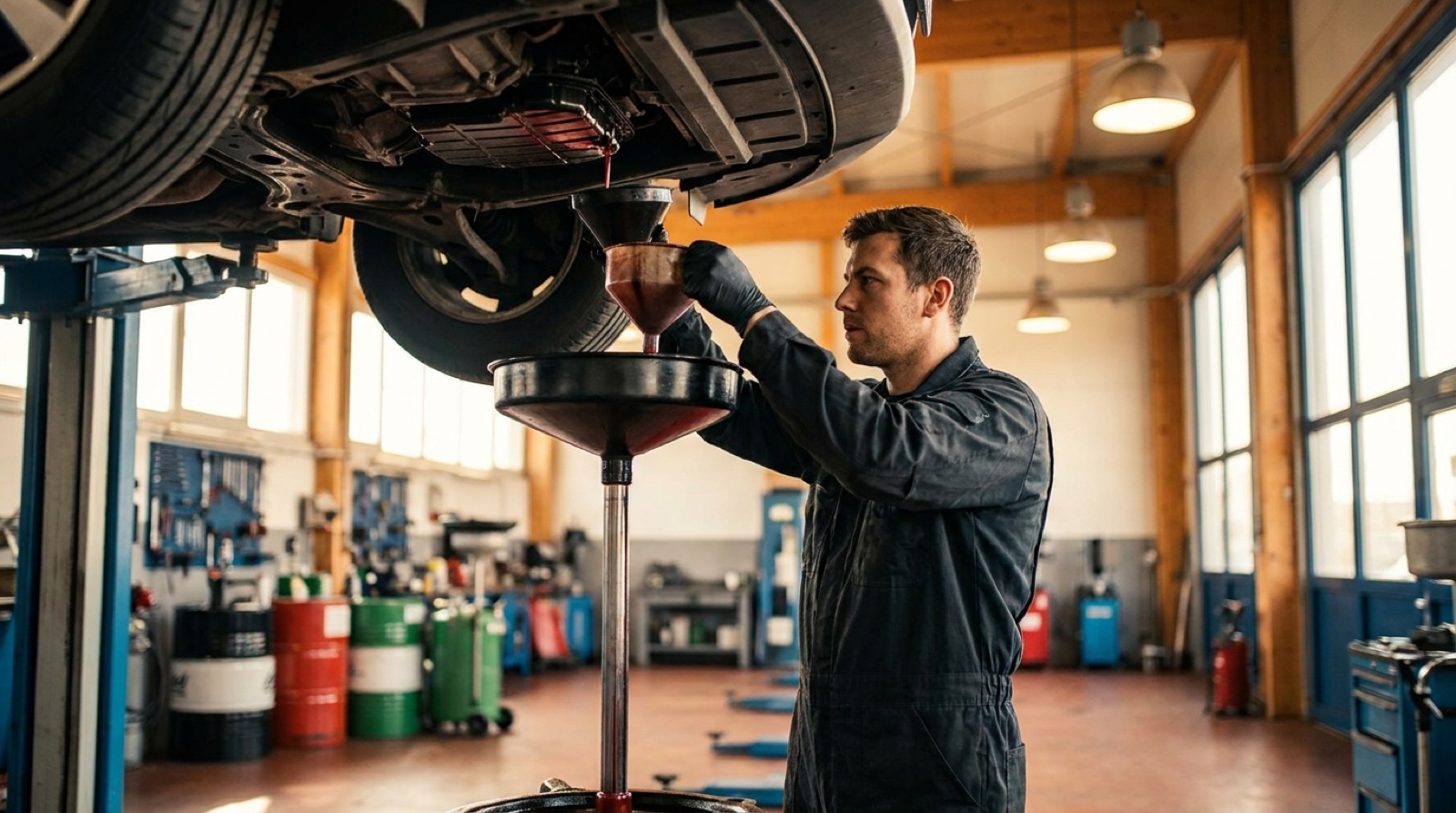
The Short Answer Is Yes
Almost every automatic and CVT transmission on the road needs fresh fluid at some point. The "lifetime fluid" label on many newer vehicles means the life of the warranty, not the life of the car.
The real question is when. That depends on the type of transmission you have and how hard you work it in the Las Vegas valley.
What the Fluid Is Actually Doing
Transmission fluid is not just a lubricant. Inside an automatic it also works as hydraulic fluid, as a coolant, and as a friction modifier that lets the clutch packs grab at exactly the right moment.
As it ages it oxidizes, loses those friction properties, and collects clutch material and fine metal particles. Shift quality degrades long before anything actually breaks, which is why the early symptoms are so easy to ignore.
Intervals by Transmission Type
Your owner's manual is the starting point, and most manuals list a severe service schedule alongside the normal one. Stop and go traffic in 110 degree heat puts most Las Vegas drivers squarely in the severe column.
| Transmission Type | Typical Interval | Notes |
|---|---|---|
| Conventional automatic | 45,000 to 60,000 miles | Sooner if you tow, haul, or sit in daily traffic |
| CVT | 30,000 to 60,000 miles | The least forgiving of old fluid. Requires the exact fluid the manufacturer specifies. |
| Dual clutch | Around 40,000 miles | Wet clutch designs need service more often than dry |
| Manual | 60,000 to 90,000 miles | Inexpensive gear oil, and the most commonly forgotten service of all |
Why lifetime fluid is a misleading term
Sealed transmissions often have no dipstick, which discourages owners and quick lube shops from checking anything. The fluid still degrades on the same timeline as any other fluid.
Manufacturers calculate lifetime against a moderate climate and moderate use. Southern Nevada is neither.
Symptoms That Mean You Are Overdue
- A pause of a second or more before the car engages when you shift into drive or reverse
- Engine revs flaring between gears instead of a clean handoff
- A shudder at steady highway speed, often a sign the torque converter clutch is slipping
- Whining or humming from a CVT that rises with vehicle speed
- Harsh or clunky downshifts as you slow to a stop
- Fluid that smells burnt or looks dark brown instead of red or amber
Transmission trouble also sets codes, so a dash warning is worth taking seriously. If a light comes on alongside any of the above, start with a scan to read the stored codes before assuming the worst.
Heat Is the Real Interval in Southern Nevada
Mileage is a proxy. Heat is what actually destroys transmission fluid, and fluid temperature climbs fastest under load when ambient air is already brutal.
A loaded summer crawl on I-15 or a grade climb out toward Henderson generates more fluid stress in an hour than weeks of mild commuting. As a rough industry rule, every 20 degrees of additional fluid temperature above roughly 175 degrees cuts fluid life in half.
Most vehicles route transmission fluid through a cooler inside the radiator, so a neglected cooling system quietly cooks the transmission too. If your coolant is old or the temperature gauge has been creeping up, a cooling system service protects more than just the engine.
Drain and Fill or Full Exchange?
A drain and fill removes roughly 40 to 50 percent of the fluid, since a large share stays trapped in the torque converter and cooler lines. It is gentle, inexpensive, and works well when done on schedule.
A full exchange with a machine replaces nearly all of it and is the better choice if you are close to the interval and the fluid still looks reasonable. The old warning about flushing a badly neglected transmission has some truth to it, which is why fluid condition should be inspected before anyone picks a method.
If your vehicle has 120,000 miles on fluid that has never been touched and it is already slipping, new fluid will not undo the wear. That situation calls for a proper diagnosis first, not a guess.
Cost Now Versus Cost Later
| Service | Typical Range |
|---|---|
| Drain and fill | $150 to $250 |
| Full fluid exchange with filter | $250 to $400 |
| CVT fluid service | $200 to $350 |
| Rebuilt or replacement transmission | $3,500 to $7,000 and up |
That gap is the entire argument. Skipping a $250 service to risk a $5,000 one is bad math on any vehicle.
It is the same logic behind sticking to a regular oil and filter schedule. Cheap fluid replaces expensive parts.
What to Do Next
Check your maintenance records first. If you cannot find a transmission service and the odometer is past 50,000 miles, it is worth an inspection.
We serve drivers across Spring Valley, Enterprise, Paradise, Summerlin, Henderson, and North Las Vegas from our shop on South Decatur. Get in touch for a quote and we will tell you honestly whether your fluid needs attention now or can wait another year.